
How to Choose a Retractable Awning for Your Allentown PA Home


August has a way of making things clear. You’ve spent most of the summer watching your patio work against you — the stretch of afternoon hours when the sun makes it unusable, the evenings that end earlier than anyone wants, the outdoor furniture that’s been baking in direct sun since May. By now you probably have a good sense of whether your outdoor space is actually serving your household.
For homeowners who decide this is the year to fix it, timing still works in your favor. Most Sunesta awning installations happen within a few weeks of placing an order. Order in August and there’s a real chance you’re sitting under your new awning before the season ends — and you’ll have it ready from the first warm day next spring.
This guide covers what goes into choosing a retractable awning for a home in the Lehigh Valley: the practical factors, the specs that matter, and what to expect when you’re ready to move forward.
Why a Retractable Awning, Specifically
Fixed shade structures — pergolas, shade sails, permanent fabric canopies — have their uses. But they commit you to one configuration regardless of conditions. A clear October morning, a cloudy day in July, a situation where you want the space wide open for a party and covered during the hottest two hours of the afternoon: none of those work well with a fixed structure.
A retractable awning extends when you want shade and retracts when you don’t. Motorized models handle this with a wireless remote or smartphone app, which makes adjusting for conditions practical rather than inconvenient. Most homeowners find they actually use the awning more often than they expected, precisely because adjusting it takes no effort.
For a comparison point: patio umbrellas work well for a single chair or a bistro table. They don’t scale to a full patio or deck without gaps in coverage and real stability concerns. A properly sized retractable awning covers the full outdoor area — the table, the chairs, the pathways between them — as a single system.

What to Consider When You Start Shopping
A few practical factors shape which awning is right for your home. Understanding these before the free estimate makes the conversation more productive.
Size and Projection
Coverage comes down to two dimensions: width (how far the awning spans across your home’s exterior) and projection (how far it extends out from the wall toward the yard). The Sunesta can be custom-sized up to 40 feet wide with a projection of up to 14 feet 8 inches. These aren’t standard shelf sizes — every unit is manufactured to your specific dimensions. Most homeowners want coverage that spans the full width of the patio or deck, with enough projection to reach the main seating area. That calculation is easier to do on-site than on paper, which is part of why the in-home estimate is useful.

Mount Type
Where the awning attaches to your home determines which configuration works. Wall mounting is the most common setup — the brackets attach to the home’s exterior wall above the patio door or window opening. Soffit mounting works when there’s an overhead soffit the brackets can attach to instead. For homes where the roofline extends over the patio, or where wall and soffit mounting aren’t practical, roof-mounted awnings are a third option that works with the roofline itself.
Direction
South- and west-facing patios take the most direct afternoon sun and benefit most from overhead coverage. East-facing patios are more comfortable in the afternoon but may benefit from morning shade. Knowing your orientation helps with sizing decisions — specifically, how much projection you need to cover the area during the hours when you most want to be outside.
Motorized or Manual
Motorized awnings extend and retract with a wireless remote or via the My Link app on your phone. Manual awnings use a hand crank. For patios that get regular use, most homeowners choose motorized — the ability to adjust the awning based on changing conditions is a real-world factor in how often it actually gets used. Motorized units can also be paired with a motion sensor accessory that automatically retracts the awning when wind speed exceeds a safe threshold, which protects the unit during sudden afternoon storms.
The Sunesta Specs
Not all retractable awnings are built to the same standard. For homeowners comparing options, the Sunesta‘s credentials are worth understanding as concrete facts rather than marketing language.
TÜV Rheinland Tested & Certified
TÜV Rheinland is an independent German testing organization that evaluates products against internationally recognized performance standards. The Sunesta’s certification means an outside lab — not the manufacturer — verified the engineering and performance. This is the same third-party verification model used in other regulated industries.
Miami-Dade County Approval
Miami-Dade County developed some of the strictest building codes in the country following Hurricane Andrew in 1992, specifically for products that need to perform under high-velocity wind conditions. The Sunesta carries this approval. For homeowners in the Lehigh Valley, the relevance isn’t hurricanes — it’s that this certification indicates a product designed and tested to hold up under the kind of stress that causes lesser awnings to fail.
Lifetime Frame Warranty
The Sunesta frame carries a lifetime warranty, backed by Sunesta directly. The fabric carries a ten-year warranty. The motor carries a five-year warranty. These are Sunesta’s commitments in writing, provided with every installation through an authorized dealer.
Manufactured in the United States
As a Sunesta dealer, all of our awnings are built and assembled in Jacksonville, Florida. Every order placed through an authorized dealer like Designer Awnings is manufactured to the customer’s specific dimensions — not pulled from a warehouse.
SmartCode
When your order enters production, Sunesta’s SmartCode system assigns a unique identification number that tracks the unit from manufacturing through delivery. It’s a logistics tool that tells your installer exactly where in the production process your order is.
Fabric Selection: Consequential in Ways People Don’t Expect

The fabric is the part of a retractable awning that does the actual work. Designer Awnings offers over 150 acrylic fabric options, including premium selections from Staler and Sunbrella — two brands recognized in the outdoor fabric industry for color retention and performance.
Solution-dyed acrylic fabrics hold their color because the pigment is locked into the fiber during manufacturing rather than applied as a surface treatment. This matters because an awning in direct Pennsylvania sun is experiencing meaningful UV exposure every time it’s extended. Fabrics that aren’t solution-dyed will fade visibly within a few seasons — often faster than homeowners expect.
Beyond color, the fabric affects the experience underneath it. A lighter-colored, more open-weave fabric allows more ambient light through and feels less enclosed. A denser, darker fabric creates a cooler, more sheltered environment under the awning. Neither is universally better; it depends on how you use the space and what you’re solving for.
View our fabric selection to get a sense of the range. The free estimate includes an on-site fabric review — our team brings samples to your home so you can evaluate them in the actual light conditions of your patio, against your home’s exterior. That’s a more useful comparison than trying to judge colors on a screen.
When to Consider Adding Screens
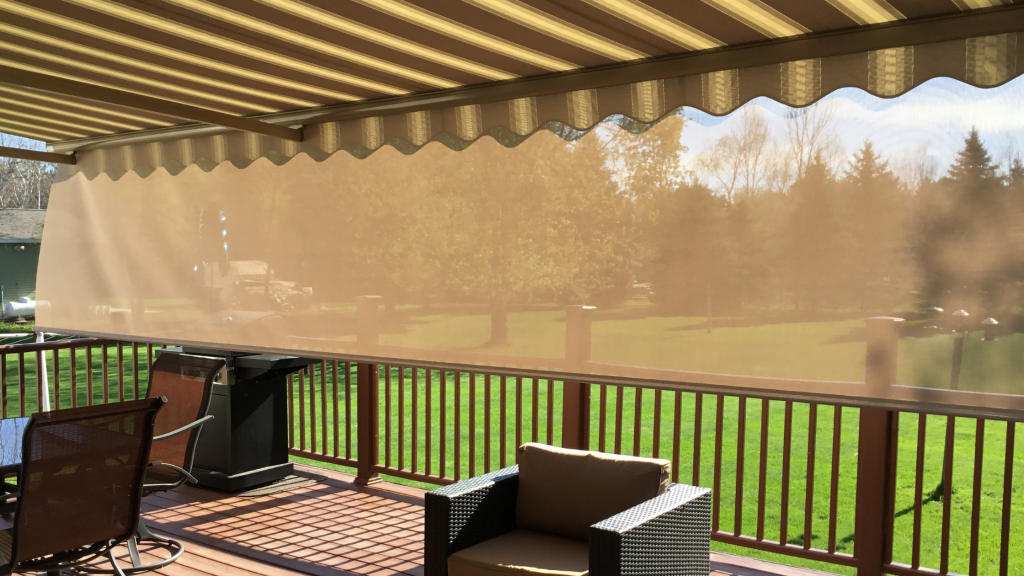
An awning handles overhead sun and heat. It doesn’t address insects, late-afternoon glare coming in from the side, or persistent wind that makes outdoor dining less enjoyable than it should be. If any of those are part of why your patio goes unused, a retractable patio screen covers what an awning alone can’t.
Two systems serve this purpose. The Sentry uses a captured edge rail design — the screen fabric runs along guides on both sides, keeping it taut and stable. It can be installed up to 18 feet wide and 12 feet tall, and comes in five frame finishes: white, beige, clay, brown, and bronze.
The Sunroll uses a free-hanging system with rod-and-cable tension, reaches up to 20 feet wide, and offers over 190 colorfast acrylic fabric options for homeowners with specific aesthetic or functional requirements.
Both retract fully when you don’t need them. For households that use the patio across a range of conditions — morning coffee, afternoon use, evening dinners — an overhead awning combined with retractable side screens covers the full situation that an awning alone doesn’t. Both screens in the Sunesta line are custom-measured and professionally installed.
What the Free In-Home Estimate Involves
Designer Awnings offers free in-home estimates for homeowners across Allentown, Bethlehem, Easton, Reading, and throughout Berks, Lackawanna, Monroe, Luzerne, Carbon, Northampton, Schuylkill, and Lehigh Counties. The process is direct.
You reach out, we schedule a visit at a time that works for you, and our team comes to your home to measure the space, review your mounting options, and walk through fabric and color selection on-site. There’s no pressure and no obligation. The in-home visit is where the real decision-making happens — coverage, projection, and fabric appearance are much easier to evaluate in the actual space than on a website.
If you decide to move forward, your order goes into production. Most customers receive their awning within a few weeks. We’ve been doing this in the Lehigh Valley for over 25 years, and we know which configurations hold up in a Pennsylvania summer and fall.